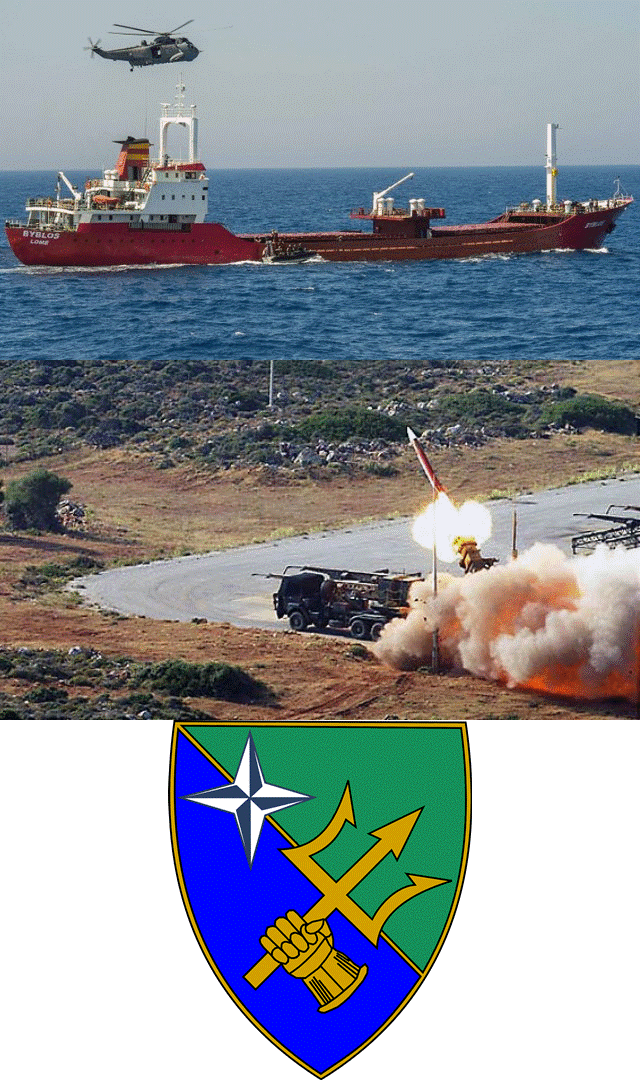
The maritime domain was the focus of the final day of the Military Committee’s (MC) visit to Portugal. The Military Representatives were briefed by Commander MARCOM, Vice Admiral Clive Johnstone, on the Maritime Environment with additional presentations on specific NATO maritime activities such as those in the Black Sea region and Operation Sea Guardian. Maritime security is high on NATO’s agenda. As part of the 2011 Alliance Maritime Strategy and in line with the Alliance’s maritime posture, Allied decided at the Warsaw Summit in July 2016 to transform article 5 operation Active Endeavour into a maritime security operation named Operation Sea Guardian. This operation was created at the Warsaw Summit in July 2016. It can perform a broad range of maritime security tasks and is currently operating in the Mediterranean Sea. You can read more about Operation Sea Guardian on NATO’s website.
These presentations were followed by a briefing by STRIKFORNATO (NATO’s Naval Striking and Support Force, based in Oeiras, Portugal)) on its mission, structure, and activities intended to inform the MC of how STRIKFORNATO works to integrate High-End US assets into NATO’s Maritime capability and provide rapidly deployable maritime and amphibious forces to Supreme Allied Commander Europe (SACEUR). The final presentation of the MC’s visit was on the topic of Ballistic Missile Defence, providing the MC with an overview of the status of this important NATO capability, the range and scope of protection it affords, and future plans. Proliferation of ballistic missiles poses an increasing threat to Allied populations, territory and deployed forces. Many countries have, or are trying to develop or acquire ballistic missiles. The proliferation of these capabilities does not necessarily mean there is an immediate intent to attack NATO, but it does mean that the Alliance has a responsibility to take this into account as part of its core task of collective defence. You can read more about NATO’s Ballistic Missile Defence capability.
The Chairman of the MC, General Petr Pavel (Czech Army) wrapped up the final day and the MC’s visit more generally by thanking all involved in the organization of the visit, including the JALLC and Portugal as the Host Nation, and emphasized the need for continued discussion in the MC on many of the topics touched upon during this productive and successful off-site session.
From 26-28 February, NATO’s Military Committee (MC) visited Allied Command Transformation (ACT), one of the two NATO Strategic Commands. This year, at the request of Supreme Allied Commander Transformation (SACT), General Denis Mercier (French Air Force), the JALLC hosted the visit at NATO’s facilities in Lisbon and Oeiras in Portugal.