On February 27 and 28, 2018, 50 participants from 21 countries came together to Neuilly-sur-Seine, France, for the inaugural Science and Technology Organization (STO) Technology Trends workshop, organized by the STO Office of the Chief Scientist and hosted by the STO Collaboration Support Office.
This two day meeting was the first of two workshops aiming to identify technology trends that will be potentially disruptive for defence in the short, medium, and long term up to and beyond 20 years. Nations need to identify and assess militarily relevant technology trends in order to understand how these trends could influence the future operating environment and the capabilities of Allies, Partners, and potential adversaries.
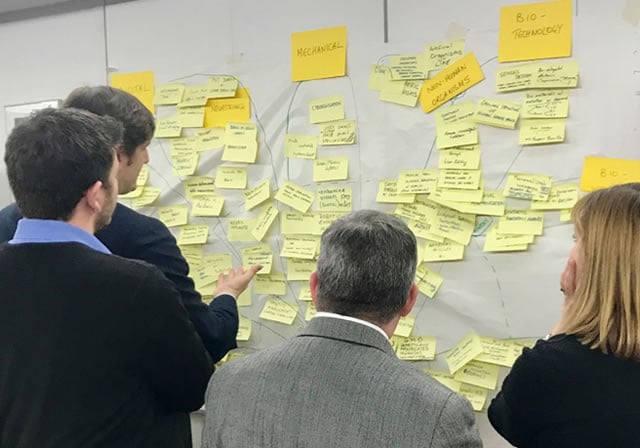
In the morning of the first day, experts from the Fraunhofer INT (Germany), the Finnish Defence Research Agency (Finland), Armasuisse (Switzerland), TNO (The Netherlands), and Defence Research and Development Canada (Canada) briefed participants on the technology trends being monitored by their respective nations, and representatives from the STO Panels and Group provided updates on their Technology Watch cards. These briefs served as inspiration for the rest of the workshop, in which participants engaged in lively brainstorming about technologies that may disrupt defence in the near (< 6 years), medium (6-20 years), and long (20+ years) term. Under the guidance of NATO alternative analysis facilitators from Allied Command Transformation (ACT): WO Tibor Karamos (HQ Supreme Allied Command Transformation (SACT)), Ms Katie Mauldin (Joint Analysis and Lessons Learned Centre (JALLC)), and Cdr David Stoffell (HQ SACT), participants arranged individual ideas as leaves on trees representing broader technology categories, with branches growing from near to long term.
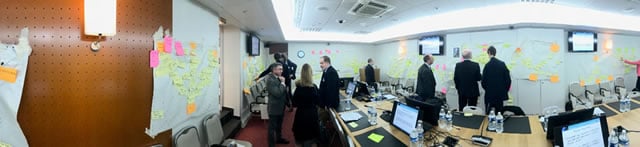
The next stage of the workshop involved pruning ideas and cross-fertilization between trees for refinement. Then participants voted on the branches with greatest potential impact. Trees with the largest number of votes were further refined by small groups of participants, and were then presented at the end of the workshop. The ten trees presented encompassed the following areas: Space, New Weapons, Autonomous Systems and Countermeasures, Energy, Human Capability Enhancement, Computing Superiority, Applications of Artificial Intelligence, Sensors, Assured Connectivity, and Manufacturing. Additional trees identified as important covered Ethics, Culture, and Environment.
The first workshop was a great success, not only resulting in the identification of several technology trends likely to be disruptive to defence in the future, but also offering participants the opportunity to network with other experts in the fields of science, technology, and foresight from NATO and partner nations and organizations.
The second workshop in this series will invite military personnel to offer their input on the military applications of the technology trends identified in the first workshop. A full report based on the results from both workshops is expected in November of 2018.
To join the NATO technology trends community space, where you can access slides from this workshop, please follow this link: https://scienceconnect.sto.nato.int/spaces/4146/posts.